


To update details in your Aadhaar, you need to present the supporting documents (not applicable for mobile number, email or biometric updates). See the list of acceptable documents here - uidai.gov.in/images/commdoc…
Showing posts with label gst. Show all posts
18% GST on Aadhaar Update Likely Soon; Updating Biometric, Demographic Details Set to Cost More
New Delhi, Feb 6: Aadhaar updating that costs Rs 25 is now set to get costlier with the Unique Identification Authority of India (UIDAI) now planning to impose 18 per cent Goods And Services Tax (GST) on the service. According to reports, the UIDAI has decided to charge an additional 18 per cent GST on not all, but some specific services related to Aadhaar.
The UIDAI currently charges Rs 25 for demographic update that includes name, address, date of birth, mobile, gender and email. It also charges the same amount for biometric updates. This amount will now be costlier by Rs 4.5 with 18 per cent GST.
UIDAI has also issued a complaint forum for issues related to overcharging. If you are asked to pay more than the prescribed amount, you can report by calling 1947 (toll free) or writing to help@uidai.gov.in.
The UIDAI also tweeted the list of support documents that will be needed to update Aadhaar. “To update details in your Aadhaar, you need to present the supporting documents,” UIDAI tweeted. This will not be applicable for mobile number, email or biometric updates.
To get the updates done, you will have to visit the nearest Aadhaar centre at a bank branch or post office.
Flying may get expensive: Domestic airline cos to increase air fares as GST to pinch cost of operations

Domestic airline companies may be left with no choice but to increase air fares going ahead, as the rollout of the Goods and Services tax (GST) from 1 July is likely to push up cost of operations.
The government will levy tax on any import of spare components by airline companies under GST, which is not taxable under the current regime. Similarly, aircraft lease rentals will also attract GST, The Economic Times report said.
"Under GST, airlines will be taxed for importing spares for their use and on aircraft lease rentals, and these are not being taxed in the current regime. Any new tax on the aviation industry, which operates under thin margins, may drive fares higher," The ET report said quoting a senior airline executive.
Besides this, domestic aviation companies will also have to deal with reduction in input tax credits on revenues earned through economy class seats, which is expected to crimp operating flexibility, said the report.
Domestic aviation companies also complain that lower input tax credits on economy class travel could further dent revenues, especially, of no-frills carriers such as SpiceJet, IndiGo and GoAir that mainly deal in economy class seats.
However, foreign carriers are in an advantageous position over their domestic counterparts, as the government allows foreign airlines to fully reclaim input tax credits on premium travel. Since, most foreign airlines sell a major portion of premium class travel, the new regime is expected to benefit overseas players.
"For premium travel (IGST rate of 12 percent), full ITC reclaim is available on both input goods and services. Our Indian-based members are concerned that the ITC restriction associated with the economy class may favour foreign carriers over domestic carriers as the former tend to sell a larger portion of premium class travel. It is requested that full ITC reclaim ability also apply on economy class travel," the report said quoting Alexandre de Juniac, director general of global industry grouping IATA.
Another key issue facing local aviation firms is that the introduction of GST will make direct flights to international destinations expensive for players such as Air India, while stopover flights via hubs of international carriers could cost less.
How India’s GST in its current avatar deviates from global practices
A multi-tier tax structure and complex rules make GST implementation a herculean task.

A hundred-and-forty countries are already familiar with the goods and services tax (GST) or value-added tax. But in its current form, India’s GST is complicated and very different from the global variety. A multi-tier tax rate structure and complex rules make execution of this mammoth indirect tax a herculean task.
Unlike other nations, goods and services in India will be charged at different rates depending on the categories they belong to. Tax rates for 1,211 items have been finalized, though rates on six crucial and controversial items including gold and beedi are yet to be decided.
For services like hotels, restaurants and transportation, tax rates have been fixed based on room tariff, turnover of business, etc. This, say tax experts, is not in line with the international practice, where a uniform rate is applicable on a service irrespective of the value or status of the business.
As the accompanying chart shows, barring Canada, the threshold for GST applicability in other countries is higher than in India. A higher threshold was desirable as it would have reduced the tax burden on small businesses.
“SMEs who undertake interstate transactions, will have to register, irrespective of this threshold. Those within interstate transactions can opt for composition levy, where the threshold is Rs50 lakh, this will be useful to mostly those who do business-to-consumer transactions,” said Archit Gupta, founder and chief executive of ClearTax.com.
Meanwhile, Amit Bhagat, partner (indirect tax) at PwC India, foresees the concept of reverse charge—which comes into play when one buys goods from an unregistered GST firm—as a major issue. He added that the number of returns companies will have to file in India under GST is also higher than what it is in other nations; though automated, it still raises compliance costs.
The exemptions list too is limited in other nations, say tax experts. In India’s case, most services-related exemptions have been retained for now. The fate of item-wise and area-wise exemptions is yet to be known.
Despite ambiguity still prevailing on some GST rules and rates for certain goods, the government is not in a mood to give its 1 July implementation deadline a rethink. In Malaysia, more than a year’s time was given to the industry to prepare for the tax change. The fear is that lack of preparedness due to paucity of time may lead to near-term disruption for businesses.
However, what worries tax experts the most is the anti-profiteering clause, as it has been unsuccessful in yielding the desired results in countries where tested. The clause requires businesses to pass on the tax reduction to the end consumer by way of a commensurate reduction in prices. It remains to be seen whether its outcome will be any different for India.
Failure or delay in price reduction would have a bearing on inflation. Though the government is confident of GST being non-inflationary, international experience suggests otherwise.
“In numerous countries, GST tax was introduced at a lower rate than pre-existing tax rate. Despite that, the GST pushed up inflation for one year in all the five countries in our study (Australia, Canada, Japan, Malaysia and Singapore), after which inflation moderated. In some countries, the pass-through of higher tax costs by firms occurred with a lag, as firms took time to fully assess the cost implications of the new tax structure,” Nomura said in a recent report.
To conclude, a simpler tax law results in better tax compliance and improved tax collection efficiency. But with a complex GST, India may have many more teething troubles to overcome compared to other countries that have adopted this tax.
Tag :
gst,
gst applicability
ICAI to bring major change in CA course due to GST
Institute of Chartered Accountants of India (ICAI) is planning to revise study module to incorporate GST knowledge for its students. At least two tax papers of the course will see “big changes”, the Institute for Chartered Accountants of India has said.

CAI president M Devaraja Reddy said since GST is an indirect tax law, it will affect the syllabi of all subjects related to indirect taxes. “Part II of paper 4 (indirect taxes) of intermediate course and paper 8 (indirect tax laws) of final course will be altered.” ICAI president, M Devaraja Reddy, said, “Once GST gets implemented in the country , service tax law, excise law, CST law and VAT laws contained in these papers will be subsumed into GST. However, customs laws will continue in these papers even after implementation of GST because customs duty is not being subsumed in GST.”
Formal announcement would be made after final GST Law is in place. “The methodology for designing the syllabi and the time when the same will be made applicable will be decided by the Council of ICAI. Students will be informed well in advance whenever the new syllabi would be made applicable,” he said.
GST Council Lowers Rates For These Categories
The Goods and Services Tax Council revised the tax rate for 66 categories on Sunday, after considering 133 representations made by various trade and industry bodies, said the Union Finance Minister Arun Jaitley, in a press briefing after the meet ended.
Goods that are going to attract a lower rate include products like tractor components, ball bearings and select packaged goods like pickles and ketchup. Another sector that could benefit from the lower tax rate includes publishers printing drawing books and note books. Insulin is also going to be taxed at a lower rate under the new structure. Direct-to-home set top boxes will also attract a lower rate under the revised list.


GST Rates PDF India 2017 (Item Wise List) Goods Services
GST Rates in India for 2017 have been
provided as Item Wise list and available in PDF Download. The Rates of
GST is different for Goods and Services. All GST Rates in India can be
categorized into Five. One of the most famous category is the Zero Rate GST (Also called as GST Exemption
Goods) which includes farm produce etc. 18% GST Rates in PDF has been
specified for most number of products. You should understand that, these
GST Rates will be changed every year based on the feedback from the
suppliers and the representatives of the State Governments of India. The
GST Rates PDF Item Wise List has been optimized for mobile viewing.
GST Rates List Item Wise India 2017
- 0% GST Rate – Milk, Meat, Sindoor etc.
- 18% GST Rate – Paneer, Stent, Vegetables etc.
- 12% GST Rate – Agarbatti, Bhutia, Animal Fat etc.
- 18% GST Rate – Cameras, Steel Products, Mineral Water.
- 28% GST Rate – Automobiles, ATM, Shampoos etc.
Download GST Rate Chart for Goods & Services PDF
Below we have provided the total list of GST Rate for Services in PDF format and divided into the each tax slab rate.
| GST Rates for Goods PDF | Download |
| GST Rate for Services in PDF | Download |
GST Rates for Motor Cycles and Water Heaters
The Central Government has fixed a standard 28% GST rate for Motor Cycles (Two Wheeler) and also for Water Heaters (Geyser).
GST Rate on Tobacco
The Rates of GST on Tobacco Products has
been fixed at 5%. However, the CG has decided to limit the rate of cess
on tobacco products at INR 4,170 per 1,000 sticks or 290 % ad valorem.
GST Rate on Gold & Jewellery
The GST Council has not yet decided on the rate of GST on Gold and Jewellery Products in India.
If the customer returns the jewellery to
the seller, the 18% tax paid at the time of purchase can not be
regained. In other words, the value of the jewellery will reduce by 18%
GST paid at the time of purchase.
Hence, the buyers will get severely impacted. The government is still mulling over the mechanism for GST. Therefore, this impact is tentative and may change as more information flows in on GST rules.
As per the present information, under
GST, gold ornaments would be subject to 18% tax, which the jeweller can
adjust with input credit. This 18% tax has to be borne by the end
customers. Therefore, the final prize of the jewellery increases.
GST Rate on Cars Automobiles
The Cars and Automobiles in India are going to attract the highest rate of GST, that is 28% tax bracket.
Unlike the multiple incidence of
taxation levied currently, the new tax structure will see a uniform rate
of 28 per cent on cars, said a person with knowledge of the decisions
made at the GST Council meeting. An additional cess of 1 per cent and 3
per cent is being discussed for levy on small petrol and diesel cars,
respectively.
Products Attracting 12% GST Rates

- Frozen meat products
- Butter, cheese, ghee
- Dry fruits in packaged form
- Animal fat
- Sausage
- Fruit juices
- Bhutia
- Namkeen
- Ayurvedic medicines
- Tooth powder
- Agarbatti
- Colouring books
- Cell Phones
Products Attracting 18% GST Rates
Flavored refined sugar, pasta,
cornflakes, pastries and cakes, preserved vegetables, jams, sauces,
soups, ice cream, instant food mixes, mineral water, tissues, envelopes,
tampons, note books, steel products, printed circuits, camera, speakers
and Monitors.
Products Attracting 28% GST Rates
Chewing gum, molasses, chocolate not
containing cocoa, waffles and wafers coated with choclate, pan masala,
aerated water, paint, deodorants, shaving creams, after shave, hair
shampoo, dye, sunscreen, Wallpaper, ceramic tiles, water heater,
dishwasher, weighing machine, washing machine, ATM, vending machines,
vacuum cleaner, shavers, hair clippers, automobiles, motorcycles,
aircraft for personal use, and yachts.
Products Attracting 0% GST Rates
Fresh meat, fish chicken, eggs, milk,
butter milk, curd, natural honey, fresh fruits and vegetables, flour,
besan, bread, prasad, salt, bindi. Sindoor, stamps, judicial papers,
printed books, newspapers, bangles, handloom.
GST Rates are Standard Across
The above mentioned GST Rates appply to
all the following States such as Andhra Pradesh (AP), Arunachal
Pradesh, Assam, Bihar, Chhattisgarh, Delhi, Goa, Gujarat, Haryana,
Himachal Pradesh, Jammu & Kashmir, Jharkhand, Karnataka, Kerala,
Madhya Pradesh, Maharashtra Manipur, Meghalaya, Mizoram, Nagaland,
Odisha (Orissa), Punjab, Rajasthan, Sikkim, Tamil Nadu (TN), Telangana,
Tripura, Uttar Pradesh (UP East & UP West), Uttarakhand, West
Bengal(WB).
GST would not be charged at every point of sale like other indirect taxes so in this way, market would be developed.
The introduction of GST in the country
will impact real estate market. This would increase new home buying
price by 8% and reduce buyers’ market by 12%.
There is no doubt that in production and distribution of goods, services are increasingly used or consumed and vice versa.
Separate taxes for goods and services, which is the present taxation
system, requires division of transaction values into value of goods and
services for taxation, leading to greater complications,
administration, including compliances costs.
In the GST system, when all the taxes
are integrated, it would make possible the taxation burden to be split
equitably between manufacturing and services.
28% rates on white goods llike airconditioners, refrigerators,
washing machines, soaps and detergents, tobacco, tobacco products, pan
masala, aerated drinks, luxury cars will be taxed 28% which have been
taxed 30% to 31% now.
People will buy more vehicles so profitability of company will increase. So its good for company.
With inter-state entry tax being
abolished under GST, the operational efficiency of the current fleet of
transporters will increase, thereby reducing the demand for commercial
vehicles in the long term. So,GST will impact the truck sales as it will
reduce the time spent by trucks at checkpoints.
Conclusion : GST Rates 2017
GST bill is good for auto sector.
Because it will reduce tax to maximum 18%. So vehicle will become
cheaper. If you have any further questions on ‘GST Rates India Item Wise
List’ editorial, post your question on our comments section below.
Textile industry "positive" about GST rate: Official

CHENNAI: The GST rate of five per cent on the textile sector has seen a lot of "positive response" from the industry, a top Central government official said today.
Whether cotton, jute or silk, "we said that the textile sector should have a five per cent GST," A Madhukumar Reddy, Joint Secretary, Ministry of Textiles, told reporters here.
The same rate applied to the sale of garments with a value of less than Rs. 1,000, he added.
"In terms of items of mass .. Read more
Whether cotton, jute or silk, "we said that the textile sector should have a five per cent GST," A Madhukumar Reddy, Joint Secretary, Ministry of Textiles, told reporters here.
The same rate applied to the sale of garments with a value of less than Rs. 1,000, he added.
"In terms of items of mass .. Read more
Source : Economic Times
GST rate for paints effectively unchanged : Industry

The decision of the GST council to tax paints at the highest slab of 28 per cent would not differ from the existing rate which was just above that, the paints industry has said.
"It is no-loss no-gain situation for the paints industry. At the existing rate structure, taxes on paints come to just above 28 per cent", newly-elected president of Indian Paint Association (IPA) Abhijit Roy said.
Roy, who is also the MD of Berger Paints, said that what the government had done is to keep the rates effectively the same.
"Our expectation was that the GST rates will be fixed at the lower slab of 18 per cent since paints is required for protection against corrosion", he told reporters here today.
Power coatings have been placed at the 18 per cent bracket, he said, adding that it constituted a small percentage of the overall paints industry size.
Roy said although paints would be taxed at 28 per cent, there would be no cess as it had not been classified as a luxury good.
Asked whether there would be disruption as the government was keen to implement GST from July one, 2017, Roy said there could some temporary disturbances initially which would die down shortly after its implementation.
Roy said sales might also suffer during that period of disruption, adding that companies having inventories of more than one year would also incur some losses.
It was unlikely that GST rate of 28 per cent would have any impact on demand.
Source: DNA India
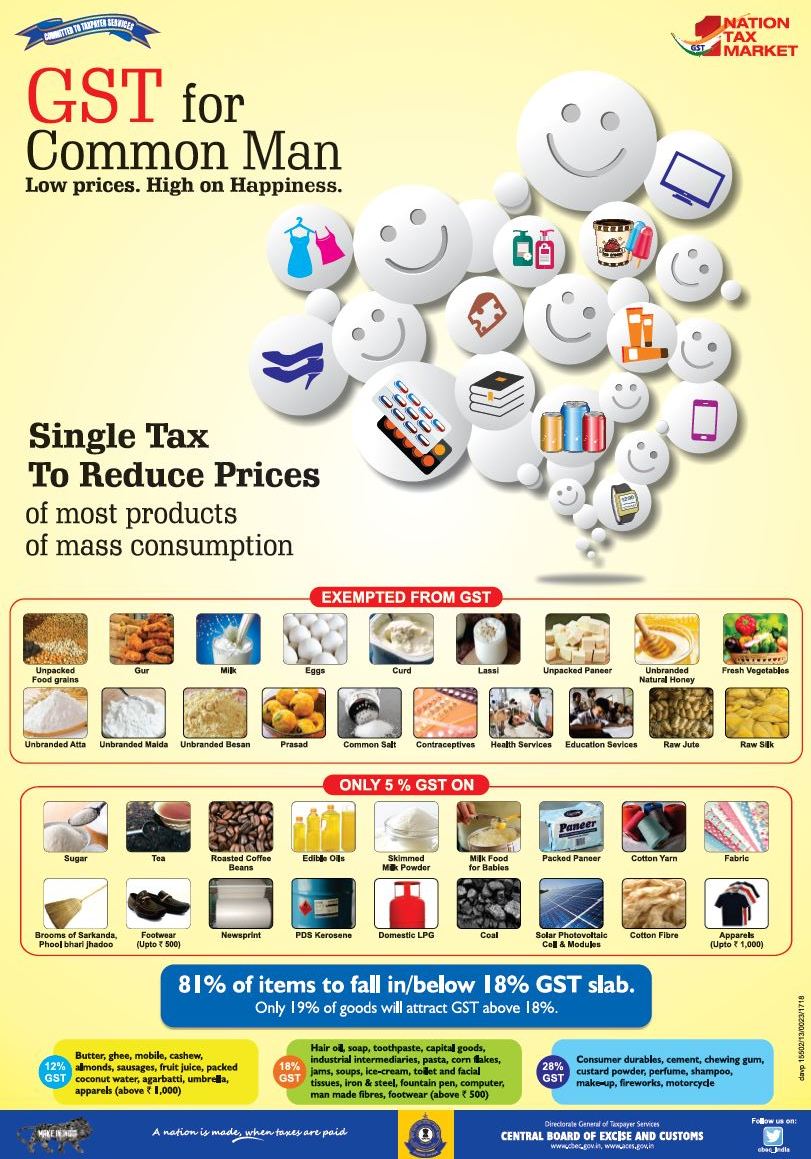
GST Rates On Essential Goods For Common Man - A Detailed List
GST or Goods and Services Tax, the upcoming indirect tax regime slated for a July 1 rollout, is expected to bring a slew of surprises to the common man. Touted as the biggest tax reform since Independence in 1947, GST will subsume all major levies including excise, service tax and VAT or value-added tax. The Central Board of Excise and Customs (CBEC), a part of the Department of Revenue under the Ministry of Finance, has released a list of GST rates - titled "GST for common man" - on everyday items used by the common man. Items such as unbranded atta/maida/besan, unpacked food grains, milk, eggs, curd, lassi, fresh vegetables and contraceptives are among the items exempted from GST, the CBEC said. "81 per cent of items to fall in/below 18 per cent GST slab. Only 19 per cent (about a fifth) of goods will attract GST above 18 per cent," it said.
Here's a list of everyday items as given by the CBEC and the tax rate you will have to shell out once GST kicks in:
Here's a list of everyday items as given by the CBEC and the tax rate you will have to shell out once GST kicks in:
GST rates: Gold 3%, shoes 5%, beedis 28%
The Goods and Service Tax (GST) Council on Saturday cleared tax rates and pending rules, including transition provisions and returns, in the final lap. With all states agreeing to a July 1 roll-out, all roads are cleared for the new indirect tax regime.
Council has revised the rules to ease compliance for taxpayers.
The GST Council has decided to tax gold and gold jewellery, along with silver and diamonds, at 3 per cent, creating a new tax slab. Rough diamonds to be taxed at, for audit trail only, the nominal rate of 0.25 per cent. The footwear of less than Rs 500 to be taxed at 5 per cent and all other footwear categories taxed at 18 per cent rate. All biscuits will be taxed at the rate of 18 per cent.
Beedis Patta will be taxed at 18 per cent and Beedis at 28 per cent without cess. Yarn to be taxed at 5 per cent and man-made textiles, at 18 per cent.

Finance Minister Arun Jaitley, who chaired the 15th meeting of the GST Council, explained the decision of council meet on GST rate, "Packaged food items sold under registered trademarks to be taxed at 5 per cent."
"The government's decision to apply 3 per cent GST on gold is an encouraging step in the current context to stabilise the industry and address the concerns of the millions employed in the industry. Together with the customs duty of 10 per cent, the total tax on gold is still high and will continue to have an impact on the jewellery industry," Somasundaram PR, Managing Director, India, World Gold Council, said.
Fabric will be taxed at 5 per cent rate. Readymade apparel will be taxed at 12 per cent and apparel priced below Rs 1,000 at 5 per cent.
Agriculture machinery will be taxed at 5 per cent whereas Jute will not be taxed in GST regime.
Final rates would be notified under the statute subsequently.
The finance minister has confirmed that a committee is to be setup for monitoring the anti-profiteering element, under which profit needs to be passed on to consumers, detailed rules on these aspects may come later.
Rule of accounts, record rules and easy bills will be discussed in the next GST Council meeting. Jaitley said, "The Council will again meet on June 11," before the roll-out of the new tax regime.
Sumit Dutt Majumdar, former chairman of CBEC, apex body of Indirect tax, said the rates as finalised on Saturday won't be inflationary. "With the revised formats of tax returns this time, I seriously doubt the ability of the GSTN to deliver on return processes and invoice matching by July 1; they might postpone return filing and invoice matching by a few months and start GST without these from July 1. But the problem will be that, going by the GST laws, credits taken provisionally by the taxpayers will not be finalised without invoice matching," he said.
The Council has given big relief to taxpayers, in the newly revised rules. Now, if Invoice is raised in the same month in which the advance is received, then there is no need to report both the transactions separately. Earlier, it was required to report the advance separately and then subsequently report again when the supply took place, thereby resulting in dual reporting of the same transaction.
"Dealers are now not required to report invoice wise HSN code details, but only a summary of HSN details needs to be reported in the GST Returns," said Harpreet Singh, Partner, Indirect Tax, KPMG India, to DNA.
State finance ministers and GSTN has given the assurance about the readiness of implementing GST from July 1, the onus now lies on the industry to prepare their IT infrastructure to align with the GSTN. Now industry to gear up their IT systems for meeting reporting requirements for filing returns on the GSTN portal.
Rajeev Dimri, leader, Indirect Tax, BMR & Associates LLP, said, "Although there is no update regarding an increase of deemed credit from 40 percent, planning a business transition to GST with the help of transition rules should now be on the agenda for all businesses."
All states have agreed to the July 1 roll-out timeline. "Transition rules have been cleared, and everybody has agreed for July 1 roll-out," Kerala Finance Minister Thomas Isaac said after the Council meeting in New Delhi.
Every manufactured product and conceivable service will have to be taxed under the rates ranging from nil to 28 per cent. The GST Council has last month fixed the rates for over 1,200 goods and 500 services -- at the slabs of 5, 12, 18 and 28 per cent. Petroleum products, property and alcohol, have not been included in GST. These products will be taxed by states like earlier.
Source : DNA India
GST: Industry gets 90 days to claim tax credit for transition stock after rollout from 1 July
New Delhi: Traders and retailers can file declarations within 90 days claiming tax credit for transition stock after the GST rolls out from 1 July. The draft transition rules for the Goods and Services Tax (GST) regime had pegged the time at 60 days.
The transition rules approved by the GST Council provides that "every registered person entitled to take credit of input tax shall, within 90 days of the appointed day, submit a declaration electronically ... specifying separately, the amount of input tax credit to which he is entitled...". It also gives commissioners the power to extend this period by further 90 days on recommendation of the GST Council.
The GST Council, chaired by Union Finance Minister Arun Jaitley and comprising state counterparts, also decided to amend the transition rules allowing traders and retailers to make claim of 60 percent against the CGST or SGST dues where the tax rate exceeds 18 percent. In cases where the GST rate is below 18 percent, only 40 percent deemed credit will be available against CGST and SGST dues. To avail this, a manufacturer can issue a Credit Transfer Document (CTD) as evidence for excise payment on goods cleared before the introduction of GST to the dealer. The dealer availing credit using CTD would also have to maintain copies of all invoices relating to buying and selling from the manufacturer to the dealer, through intermediate dealers. CTD shall be issued within 30 days of 1 July, 2017, and details of the same shall be mentioned in specified forms by manufacturer and such dealer/distributor availing the credit.

Union Finance Minister Arun Jaitley. Reuters
"This provision comes as a sigh of relief for entire dealers/distributors network of motor vehicle and other conveyances, as such dealers/distributors would get the entire credit of excise paid by original manufacturer," Nangia & Co Directors (Indirect Tax) Rajat Mohan said.
Dealers had demanded a hike in the quantum of input tax credit for transition stock and hence the GST Council in its June 3 meeting amended the transition rules. Besides, in cases where Integrated GST (IGST) is paid on sale of such goods, deemed credit would be available at the rate of 30 percent of IGST paid, if the IGST rate is 18 percent or above and 20 percent of IGST paid in other cases. The draft rules issued earlier did not mention this.
For claiming deemed credit, the goods should be leviable to excise duty or additional customs duty and the goods should not be unconditionally exempt from the whole of duty of excise. For claiming credit of service tax or VAT paid in the current regime against GST liability for supplies made in GST regime, a dealer would be required to furnish details of proportion of such supply made.
"The transition rules specify that individual states may insert a new provision giving the details of methodology of calculation of the VAT paid which would be available as ITC of state tax under specified condition," Mohan said.
Further, the government will refund 100 percent excise duty for goods costing above Rs 25,000 and bearing a brand name of the manufacturer and are serially numbered like TV, fridge or car chasis.

